Friday, September 01, 2006

PEW Poll--Demos Face "God problem"

Hat Tip: Alamo Nation

A recent Pew Research Center Poll on religion and politics in American life shows that Liberals and Democrats have poor press on their "friendliness" toward religion.

69% of those polled thought Liberals had gone too far in tyring to keep religion out of government and schools. Only 26% thought the Democratic Party was "friendly" toward religion.

Not only do Liberals and Democrats have bad press on this issue, the press sometimes actively helps ramp up sentiment against religion. A recent Oregonian editorial God and the ballot box is a case in point. Speaking of the Senatorial campaign of Florida Republican Katherine Harris the editorial opines as to why she "is having a tough time running for the U.S. Senate":

She has shown why in increasingly erratic behavior, including some impolitic comments that came out in a religious journal last week. She told it that separation of church and state is "a lie" and that "if you're not electing Christians, then in essence you are going to legislate sin" -- a position not likely to play well with Florida's many Jewish voters.


The Oregonian apparently doesn't know there is some debate about whether forbidding the making of any law "respecting an establishment of religion" (First Amendment) and separation of church and state (an old line Anabaptist and Baptist theological position before it was a political position) are coterminus.

What's more interesting is that the Oregonian is shocked--SHOCKED!--that someone might say that electing religiously affiliated people could have an effect on moral values in legislation.

Let's run the sentiment again but substitute some other groups.

How about a Muslim candidate saying to his constituency, "if you're not electing Muslims, then in essence you are going to legislate sin". Sound completely off the wall?

Or how about an "off the wall" group in which 50% believe the Bible should be more important than the People's will in influencing U.S. Laws. That was Blacks in the latest Pew poll.

Crazy Muslims. Crazy Blacks. Crazy Katherine Harris.

Not that I think Harris' statement is problem free. Lots of Christians in the past were elected and allowed slavery to persist--as did Liberal icons like Thomas Jefferson. There is still slavery among Muslims in Africa (e.g., currently in Sudan). Lots of Christians have been elected and abortion is still going strong in the U.S. I didn't see a major policy difference when Jimmy Carter (a self-described "born again" Christian) was elected president.

But, all things being equal, I think a person's religious commitment does say something about moral commitment. And on basic moral issues like concern for the unborn, the widow and orphan, and those dying of malnutrition and disease in nooks and crannies all around the world, it's amazing how much work is done by religious people and organizations in comparision to their secular counterparts. Catholic charities probably have the longest and broadest continuing history. But other major religious groups have made a real contribution. Religious commitment does count for something.

The fact that the Oregonian thought Katherine Harris' statements were so far out that they needed to write an editorial on a race that has no national implications (unlike the Lieberman/Lamont race), plays right into the Pew poll findings that Liberals and Democrats (and Liberals and Democrats in the Mainstream Press) have a tough time relating to religious commitment as it effects public life.

The people polled get the problem. Unfortunately, Oregonian editors don't--not yet.

Wednesday, August 23, 2006

Just Say No to “Dirty” Campaigns

Just got wind of this campaign mailing on behalf of State Senator Jeff Merkley (Dem.) from four “neighbors” in his senatorial district (Irene Starr, Democrat; Teena Ainslie, Republican; Dr. Tom Owen, Republican; and Dr. Howard Horner, Democrat):

Dear Neighbors:

We are writing to you to ask for your help.

Over the past two months people in our community have received seven very ugly campaign mailings from a would-be political leader named Bruce McCain.

These mailings represent everything that everyone hates about politics. McCain comes to us as the former attorney for the OCA (Oregon Citizens’ Alliance), the group Lon Mabon formed to campaign against government-aided preschools and parental leave and that brought us all those hate initiatives in the 1980s and early 1990s. McCain has hired Chuck Adams–Oregon’s premier right-wing negative campaign hatchet man–to prepare and mail these awful attacks. They are full of insults, innuendoes, misrepresentations, and outright lies. This isn’t right, and we want to do something about it!


The above is the sum total in the letter about what is wrong with McCain. In other words the four “neighbors” attack by using (surprise!) insults, innuendos, misrepresentations (and I wouldn't be surprised if there was an outright lie or two). Not a word about any of McCain’s positions vs. his opponent Jeff Merkley’s positions.

The letter ends with:

We never thought we would see in our district the type of gutter politics McCain has embraced. We want to do something about it. And we need your help. The best way we can think of to reject these types of campaign tactics is to give Jeff our well-earned support. Please join with your community to Just Say “No” to Dirty Campaigns. Please take a moment to fill out the form below and mail it back to us.


I think the best way to say “No” to dirty campaigns and gutter politics based on insults, innuendoes, misrepresentations and outright lies in Oregon communities is to throw letters like this from Irene Starr (Democrat), Teena Ainslie (Republican), Dr. Tom Owen (Republican) and Dr. Howard Horner (Democrat) in the trash. Their letter certainly does “represent everything everyone hates about politics.” No wonder so many people are registering as Independents.

Saturday, August 19, 2006

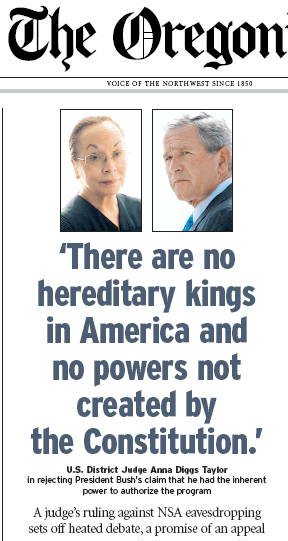
'no hereditary kings in america'

One wonders at the Oregonian headline yesterday for a Cox News Service story:

'There are no hereditary kings in America and no powers not created by the Constitution.'


This was from Judge Anna Diggs Taylor's ruling on the NSA program to track terrorists via international telephone calls and e-mails.

Has anyone ever heard of a case in American jurisprudence where the central issue was "kingship" (not to mention "hereditary kingship")?

Whatever else the ruling shows, that one phrase indicates how unbalanced Judge Taylor's thinking is. That's political boilerplate not judicial reasoning.

One wonders if when Judge Taylor's decision is struck down, Cox News and the Oregonian will run a front page headline saying something like:

"There is no rule by judicial fiat in America and no powers not created by the Constitution."

Don't hold your breath.

Tuesday, August 15, 2006

Leaks and Unnamed Sources

The Oregonian published a page one story Sunday titled "U.S. kept terror plot tightly under wraps". The article, released by the LA Times-Washington Post Service, was on the recent terror plot to blow up jetliners. I have not been able to find an online link, so here are some key parts of the text written by Dan Eggen and Spencer S. Hsu:

The homeland security secretary [Michael Chertoff] discreetly asked subordinates about plans developed months or even years ago, focused on avaiation safety, threat levels and other minutiae. In briefings, he quizzed staffers about responses to an aviation threat: What was the default plan for going to "orange alert"? What items can we ban from airplanes if we need to?

Those taking the questions--including many of Chertoff's closest aides--had no idea what was really going on, according to two senior counterterrorism officials.

Chertoff's stealthy information-gathering was just one example of the U.S. government's secretive response to an emerging terrorist plot. . . . [emphasis mine]


The story cites two negative effects of the secrecy:

1. Airport and security personnel who would have to implement any plan were not given advance warning.

Until the last hours, details of the British investigation were confined to a limited coterie of U.S. Cabinet members and seniors officials, according to interviews with more than a dozen people who were involved or have since been briefed. The approach ensured that no advance word of the operation leaked out--but also meant airlines, airports and even the Transportation Security Administration had only a few hours to ramp up sweeping new measures after being alerted to the threat late Wednesday night. [emphasis mine]


2. Some officials were irritated about not being told details before they were publicly released.

"Several sources suggested last week that the extensive secrecy irritated some officials who were kept out of the loop at intelligence and law enforcement agencies, but declined to discuss the missions in detail. Michael Jackson, Homeland Security's deputy secretary, said the secrecy "wasn't controversial. It was operational security." [emphasis mine]


Even though reporters Eggan and Hsu questioned whether high security was really necessary about "rudimentary details", they did cite two reasons for that security.

1. The first was "operational security" quoted above. In order to stop the bad guys you need to make sure that information about the investigation doesn't compromise the ability to stop the entire network.

2. U.S. officials were concerned in this case not to repeat the sort of leaks about British information on the 2005 subway bombing that had "strained relations":

Even now, three days after British authorities arrested 24 suspects--and two days after most of the suspects have been publicly named--U.S. officials are tight-lipped about the most rudimentary details of the case, citing strict British secrecy laws and a desire to avoid the strained relations that followed U.S. leaks about the 2005 subway bombings. [emphasis mine]


What's strange (as highlighted in the above passages) is the secrecy the reporters use in identifying their sources. Only three named sources are cited in the lengthy article, but unnamed sources appear again and again to substantiate facts in the story. In addition to those noted above:

- one senior U.S. law enforcement official said
- according to several law enforcement officials
- officials said
- sources have said
- according to intelligence and law enforcement officials
- one official said
- aides said
- officials said
- one U.S. counterterrorism official said
- officials said
- One U.S. official said
- according to several U.S. officials
- some officials said
- one official said
- Officials said
- officials said

One can understand why reporters might not want to list the names of all the people involved in interviews with "more than a dozen people", but to have so many facts dependent on unnamed officials, aides and sources is sloppy reporting at the least and leaves the door open for Jayson Blair-type inventive reporting.

The need for secrecy in counterterrorism investigations is obvious. It is made even more obvious by the number of leaks which compromise investigations as with the British subway bombing investigation cited above or the NY Times exposures of NSA monitoring of international calls and e-mails and the bank data program.

Aside from the question of the need for governmental secrecy on national defense issues, the style of this article raises the question of the lack of transparency by the press on sources used in reporting. Unnamed sources don't cut it.

Further, there is a blending of gossip ("irritated" officials) and hard fact. Feelings are cited as being newsworthy and having a bearing on the substantive issues involved.

One cannot help but wonder if unnamed sources and "irritations" are more a reflection of the reporters own biases than of the content of the story being reported. The mainstream media keeps shooting itself in the foot on credibility.

Saturday, August 05, 2006

Ben Stein--How to Lose--How to Win

IMDb.com photo

A couple of months ago I published a post on what two WWII vets thought about the modern preoccupation with civility in fighting a war. From their experience in WWII, they thought this was a recipe for losing a war. They saw first hand, one in the European theater and the other in the Pacific theater, the necessity of adapting to the enemy's strategy, strengths and weaknesses.

Ben Stein has recently underlined that point in the present conflict with terrorism.

We are in real serious trouble, and I'll tell you how and why I know it:

* Because the Hezbollah -- as has been well reported -- launches missiles at purely civilian targets in Israel as a matter of course, and no one in Europe or in the American left says "boo" about it. It's considered the Hezbollah's "right" to kill Israelis and when they do, they boast about it and promise to do more;

* Because it's been also well documented that the Hezbollah hides behind civilian targets and adjacent to civilian dwellings in Lebanon to fire its rockets at Israel, and when Israel fires back and mistakenly hits a home with civilians, the world of "intellectuals" and "thinkers" blames Israel and calls Israel bloodthirsty;

* Because when the Israelis kill civilians, they apologize, but when the terrorists kill civilians, they brag -- and the beautiful people scream at Eretz Israel and excuse the terrorists;


In WWII there were two standards for medics. In Europe US medics regularly helped wounded Germans--because German prisoners were grateful for help and didn't try to kill the medics. In the Pacific US medics helping wounded Japanese was a bit rare--because wounded Japanese soldiers tried to kill medics helping them.

Because US commanders, medics, politicians and the American people were able to make that distinction, the US not only won the war, but a lot of medics came home alive from the Pacific theater.

Ben Stein continues:

* Because it is impossible to beat a terrorist movement without using terror tactics, and we as a people of compassion and restraint, both in Israel and the U.S., will not use terror tactics even when survival is at stake, and this means we will not survive.

It is very much as if, after Pearl Harbor, after the bombing of London, we said, "We will fight the Japanese and the Nazis, but we will only use humane means, and we will show total restraint and will never kill civilians. And we will search our souls and agonize about every move."

It is this attitude that kept the United States from winning in Korea, in Vietnam, and now in Iraq. If we had followed that code of suicide, we would have lost World War II and the world would have been plunged into eternal darkness.


We need to listen to people who have actually won a war against people who used suicide attacks and brutality (even against medics trying to help them) as a matter of course. Because not only did those vets and their leaders safeguard the US and its way of life, but the "brutality" of US forces and the dropping of the atomic bomb caused a transformation in the Japanese. The Japanese accepted democracy and have become a peace-loving society--to their benefit and ours.

Those who won't learn from history not only are doomed to repeat it, but to fail where their betters succeeded.

Hat Tip: Mike's America

When to Intervene


Bill Buckley has a good column on the tipping point for old-line conservatives (except maybe George Will) on when US intervention becomes crucial:

The old injunction about minding your own business has always been a little problematic, because carried to formal lengths it distresses other laws, laws that have to do with being one's brother's keeper. From large-scale national perspectives, there are the laws that translate into maintaining balances of power. You can try to ignore it when you hear that Hitler has ultimate solutions about how to deal with Germany's Jews, but meanwhile it makes sense to maintain your fleet in good condition, never mind if regulating German Jews is other people's business.


There comes a point at which horrific behavior ceases to be local--if it ever was truly local for anyone who believes in a moral code. For example, should your neighbor be able to beat his wife and kids as long as you and your home are not threatened?

The threat that is looming for Buckley is Shariah law:

Much hangs on the development of Muslim practice in the 21st century. It can't remain somebody else's business exclusively if organized communities take to chopping off people's hands. The Times article describes the arrest of three women in Aceh. Their crime? They were sitting in a secluded section of a hotel corridor without their headscarves. Inasmuch as the Shariah is being developed, restored, revived, evolved, it matters greatly in what direction it is developing. We know that cheek by jowl in the Middle East we have had developments along the lines of the Taliban, with torture and death, and along different lines, as in Turkey and Egypt. It is precisely an urgent moral concern what practices will govern life and law enforcement in Iraq—and Lebanon and Syria.


What was supposed to work, short of going to war, was that the people who thought there was such a thing as cruel and unusual punishment were supposed to get together at the UN and take a stand via moral pressure, boycott/interdiction of trade or military intervention.

Unfortunately, that seems only to work if nobody wants anything that the people responsible for the infractions have--like in Rwanda, Kosovo and maybe (a huge maybe) Darfur. It didn't work well in Iraq because lots of people, including major powers, wanted what Saddam had more than they cared about what he was doing to Kurds, Shiites and anyone else causing him or his sons inconvenience.

At this point international intervention is broke. With UN peacekeepers liable to rape rather than protect, and the UN seemingly unable to come to agreement even on Darfur, let alone Hezbollah and Lebanon, there aren't a lot of choices.

One can do a "coalition" action, as is happening in Iraq and Afghanistan, but short of major US involvement, apparently no one else can get anything done.

The spread of Shariah law is not a traditional state kind of problem. But, for Buckley, the spread of Shariah law is a matter of international concern.

It has been a matter of huge reluctance even to think of, let alone refer to, a great religious-moral collision approaching, setting Islam against the Judaeo-Christian world. The old counsel is to be permissive about what other people do, especially if they are self-governing. But, in present circumstances, these do not consolidate as purely local matters. What happens in Aceh, when Islam is reviving throughout Indonesia, is exactly as reported, a matter of profound international concern.


But, what to do about it? I don't think the major problem is that the US has its hands full in Afghanistan and Iraq (not to mention Germany, South Korea and Japan). The major problem is a lack of will among US political leaders, especially the "loyal opposition" to do much of anything. When the trumpet does not sound a clear call (I Cor. 14:8), it's no wonder that the public is questioning and uncertain about any kind of intervention anywhere. We saw a real crystallizing of national will after 9/11, but it has dissipated. And the "me first" mood not only infects the international scene but the national scene. Why should California care about Oregon or vice versa? Hey we got our own problems.

Unless we choose wisely in caring about other people's problems, they will start to be our problems too. If Shariah law can prevail in Indonesia, why not France, or why not a US city?

What to do? Buckley doesn't give an answer. But, he recommends the first step: really care about what is happening to others and not just say, "It ain't my problem." Only then can we start to think of effective ways to help.

Thursday, August 03, 2006

Sad Day for Vic Atiyeh


photo from Oregon State Archives

Former Oregon Governor Victor Atiyeh recently wrote an impassioned opinion piece about the current Hezbollah-Israeli conflict. It begins:

STOP! FOR GOD'S SAKE -- STOP!

Stop this wholesale death and injury to the citizens of Lebanon.

Stop pretending that every bomb and every rocket and every cannon shell kill only a Hezbollah.

President Bush and Congress, STOP applauding and cheering on the carnage and destruction of a struggling nation.

This is not my America that treasures every human life and honors our international friends.

And, Hezbollah, STOP being the cause for the unleashing of Israel's horrendous and awesome military power, which is so superior and well supplied by America. You have rockets that seem to be aimless. They have hundreds of tanks and probably thousands of sophisticated helicopters and jet airplanes.

You cannot beat them but you give them the reason they were looking for to crush an economically and militarily weakened neighbor.


As the Oregonian notes Atiyeh is of Arab descent and has family living in Lebanon. That explains part of where he is coming from in his opinion piece.

But, it doesn’t explain why he waits until the 5th paragraph (admittedly the paragraphs are short) to even mention Hezbollah’s shelling of Israeli communities that started the conflict. It’s sort of like waiting until the fifth paragraph to note the Pearl Harbor attack in a piece wanting to stop the US from retaliating against the Japanese in WWII.

It also doesn’t explain why Atiyeh describes Israel’s military power as being “well supplied by America” and including “hundreds of tanks and probably thousands of sophisticated helicopters and jet airplanes” but succinctly describes Hezbollah’s military power as being “rockets that seem to be aimless”--as though aimless rockets are somehow not lethal. Nothing about thousands of rockets. Nothing about Hezbollah being well supplied by Iran. Nothing about the “aimless” rockets hitting women and children with no warning coming before the attacks.

It also doesn’t explain why Atiyeh is concerned about “wholesale death and injury to the citizens of Lebanon” but says not a word about Israeli casualties or the destruction caused by Hezbollah’s “aimless” rockets.

In fact Atiyeh’s cry to Hezbollah to stop seems to be based on the fact that Hezbollah “can’t win” rather than that Jews and Lebanese are dying. One wonders what Atiyeh’s view would be if he thought Hezbollah could win and destroy Israel. The right of Israeli civilians to live in peace doesn’t register as important to Atiyeh.

Atiyeh asserts that Israel was "looking for [a reason] to crush an economically and militarily weakened neighbor". To what end? To annex Lebanon to Israel? Even Atiyeh isn't that naive. So, that Iran or Syria can make Lebanon a totally compliant client-state? Why would Israel want major enemies to be closer and more powerful? Israel's wanting to crush Lebanon is "sniffing the glue" talk.

It's to be expected that Atiyeh would care about his relatives. But this anti-Israel rant which cares not a rip about Israeli casualties or a Lebanon free of Hezbollah is a more cultured version of Mel Gibson's recent conduct. Mel Gibson at least has drink to blame and has apologized. What a sad day for Vic Atiyeh.